- Answering this question is difficult because in order to analyze its worthiness, you have to first read it in depth
- Heart of Darkness should be read as literature rather than historical or autobiographical fiction, because of its narrative style and the recurring themes (personification of darkness, ironic tone, apocalypse)
- Misinterpreted as a seamen's yarn
- Should be read as an "exemplary revelation of the ideology of capitalist imperialism, including its racism and sexism"
Wednesday, April 10, 2013
Should We Read "Heart of Darkness"

Thursday, November 8, 2012
Illusion
I chose the word 'illusion' because, first of all, it sounds like what it means. Secondly, illusions have always fascinated me. I am interested in psychology and the human brain, so fooling someone using optical and auditory tricks is the perfect way to further understand their brain. For example, observe the following illustration:

Squares A and B are actually the same shade of gray. The illusion results from your brain's interpretation of the picture, which gives us insight into how it functions.

Thursday, November 1, 2012
The Wedding of Sir Gawain and Dame Ragnelle
The Story of the wedding of Sir Gawain and Dame Ragnelle begins with one of King Arthur's hunts in the evil Inglewood Forest. He is confronted by a mysterious knight, who poses him the challenge: return in one year to this exact spot with the answer to the question: what is it that women most desire? If Arthur fails to give a satisfactory answer, the knight will behead him. Arthur accepts the challenge. He is later wandering in the same forest looking for an answer to the question when he meets an old hag, Dame Ragnelle, who tells him she will give him the answer on one condition: she must be married to Sir Gawain. The hag reveals to arthur that what women most desire is the ability to make their own decisions. Arthur returns to the knight to fulfill his challenge. Sir Gawain and Dame Ragnelle are married, and the lady's curse of hideousness is partly broken. She transforms into the most beautiful woman Gawain has ever seen. She says he can choose between her being beautiful during the day, or at night. Sir Gawain tells her that she may choose, and this breaks the spell completely. And they live happily every after...

Friday, October 5, 2012
Wealtheow's New Life
My entire life has
been turned on its head. Ever since I
was a child, I have been living in the warm embrace of my family and clan. But as I have learned during my few years in
midgard, war changes many things.
Including people. Hrothgar is a
gentle man—caring, loving, respectful, and above all, immeasurably dedicated to
the well being of his people. But once
he straps on his breastplate and gauntlets, he becomes Hrothgar King of the
Danes and Lord over the great Heorot and the people of the realm. The time of gift giving is over. The drums of war thunder once again. But the roar of Hrothgar’s mighty army drowns
out even those. This is the way of men
and the gods. The only explanation for
this phenomenon is the phenomenon itself.
It has always been this way, and always will be. The only way to exist in this land is to play
the game. We are all chess pieces on the
board of war. I can move forward,
backward, sideways, and diagonally—the most powerful in the contest—yet I feel
as if I have the least power of them all.
I
began my new life in Hrothgar’s kingdom quiet and afraid. But I soon grew used to the customs and habits
the clanspeople. Although I, of course,
miss the camaraderie and friendship of the family I had grown up with, it is
for the best. Sometimes one has to give
up her dreams for the best of those she loves.
I am a sacrifice to our way of life, and a necessary offering to
preserve the safety of my family and people.
I willingly take on this position.
Honor above all else is what matters in the end of time. When the armies of all lands meet one last
time for the final battle of Ragnarok—when all men are brought to their knees
at the point of Odin’s spear—that is the time when all that one does in her
life comes to fruition. I may now live a
hollow husk of an existence, as I smile through my teeth and fill the goblets
of brutish men, but when my time in midgard finally comes to a close, I will
once again be in the warm embrace of my family.
Sometimes I wish that savage demon had
torn me limb from limb.
Wednesday, September 19, 2012
Anglo-Saxon History Summary
Anglo-Saxon History Summary
-Roman occupation (410 C.E.)
-Germanic Tribes invade Britanny:
-Angles (modern Germany)
-Saxons (modern Germany)
-Jutes (modern Denmark)
- some occupied roman settlements (walls)
- many small settlements, often made in forest clearings
- often small communities centered around a large hall
- homes were one room, with a hearth at the center
- primarily farmers, with some skilled workers (blacksmiths, woodworkers, jewelers, etc.)
- originally worshiped pagan gods (Odin, Thor, Frige)
- missionaries sent to convert to christianity (597 C.E.)
-Norman invasion (1066 C.E.)
Sources:
http://en.wikipedia.org/wiki/Anglo_saxon
http://www.bbc.co.uk/schools/primaryhistory/anglo_saxons/
- some occupied roman settlements (walls)
- many small settlements, often made in forest clearings
- often small communities centered around a large hall
- homes were one room, with a hearth at the center
- primarily farmers, with some skilled workers (blacksmiths, woodworkers, jewelers, etc.)
- originally worshiped pagan gods (Odin, Thor, Frige)
- missionaries sent to convert to christianity (597 C.E.)
-Norman invasion (1066 C.E.)
0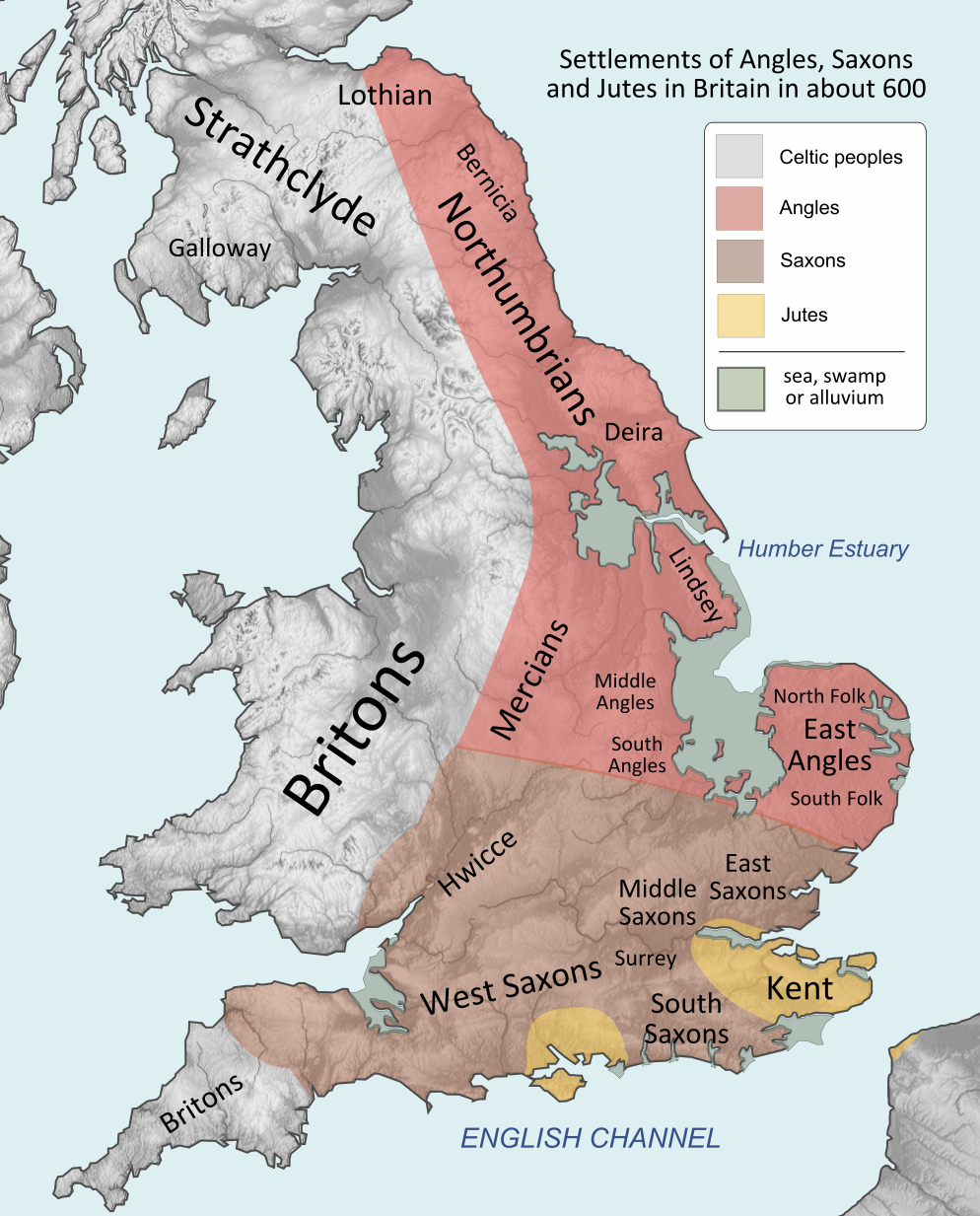
Sources:
http://en.wikipedia.org/wiki/Anglo_saxon
http://www.bbc.co.uk/schools/primaryhistory/anglo_saxons/
Thursday, August 30, 2012
Frankenstein and a Critique of Imperialism Summary
—Mary Shelley believes that social engineering should not be based on pure, theoretical, or scientific reason
—"Incidental" imperialist sentiment (such as that shown by Henry Clerval)
—Kant's three-part conception of the human subject
- Victor = natural philosophy
- Henry = practical reason
- Elizabeth = aesthetic judgement
This essay gave me a few new insights on Mary Shelley's underlying arguments in the novel. While the title implies that the essay deals with the imperialist context of Frankenstein, it mostly discusses the treatment of feminism in the novel. One thing that is rather insightful is the metaphorical connection of the three characters Victor, Henry, and Elizabeth to natural philosophy, practical reason, and aesthetic judgement,
—"Incidental" imperialist sentiment (such as that shown by Henry Clerval)
—Kant's three-part conception of the human subject
- Victor = natural philosophy
- Henry = practical reason
- Elizabeth = aesthetic judgement
This essay gave me a few new insights on Mary Shelley's underlying arguments in the novel. While the title implies that the essay deals with the imperialist context of Frankenstein, it mostly discusses the treatment of feminism in the novel. One thing that is rather insightful is the metaphorical connection of the three characters Victor, Henry, and Elizabeth to natural philosophy, practical reason, and aesthetic judgement,
Tuesday, August 28, 2012
Mary Shelley’s Attitude Toward Victor’s Work
Mary Shelley portrays Victor’s
demeanor throughout his experiment as one of ambition and ignorance. In addition, Shelley impresses on the
reader through Victor’s retrospective point of view that the earlier Victor was
toying with powers he could not hope to control: he was playing God. Early on, Victor describes himself
surpassing the bounds of life and death in order to “pour a torrent of light
into our dark world.” This
statement is analogous to the familiar “let there be light”. Victor goes on to state that “a new
species would bless me as its creator and source; many excellent natures would
owe their being to me.” Furthermore,
Victor sees himself as a potential “father” to these creatures—a biblical role
played by God, seeing his human creations as children. Through the use of biblical and
religious literary analogy, Mary Shelley has effectively designated young
Victor as one hoping to become a God among men. But she will soon dispel the possibility of such a
situation, and further suggest one’s ambition will bring much despair and
sorrow.
Throughout the remaining passage,
Mary Shelley describes the horror of the latter Victor towards his former
self. She implies something deeply
unnatural and unholy about his work, using phrases such as “Who shall conceive
the horrors of my secret toil, as I dabbled among the unhallowed damps of the
grave, or tortured the living animal to animate the lifeless clay?” The mere thought of disturbing a
gravesite brings emotions of unholy filthiness to the later Victor (and clearly
Mary Shelley as well). Attempting
to create irony in Victor’s actions, Shelley asks the reader why one would
torture living things in order to animate “lifeless clay”—why not simply be
happy with what is already alive?
Mary Shelley has a bias against Victor’s work, and more than likely
opposes it, along with other issues of her time, on the basis that any human
attempting to “play God” will eventually regret their decision, and be filled
only with terror and misery.
Subscribe to:
Posts (Atom)